Church Operations·3 min read
I’m Not Here to Pastor Your Church. Here’s What I Actually Do.
There is a version of what I do that sounds threatening to a pastor. It is not. Dr. Merrilyn Yeboah explains the difference between building operational infrastructure and pastoring and why that distinction matters for every church leader carrying too much.
May 4, 2026 · Dr. Merrilyn Yeboah
There is a version of what I do that could sound threatening to a pastor. Someone coming in, looking at how your church operates, telling you what is broken, building systems and structures. It can sound like a takeover.
It is not. And I want to be direct about why.
I serve in church leadership. I have sat in the rooms where the weight of a congregation is felt. Where follow-up falls to whoever notices. Where one person's capacity sets the ceiling on everything the church can do. I know what that pressure feels like from the inside.
That experience is precisely why I know that what I do in my consulting work is not pastoring. The difference is clear to me because I have lived on both sides of it.
I build the road. You do the shepherding. God does the growing. These are not the same job and I understand each one well enough to know where mine ends.
What the consulting work actually is
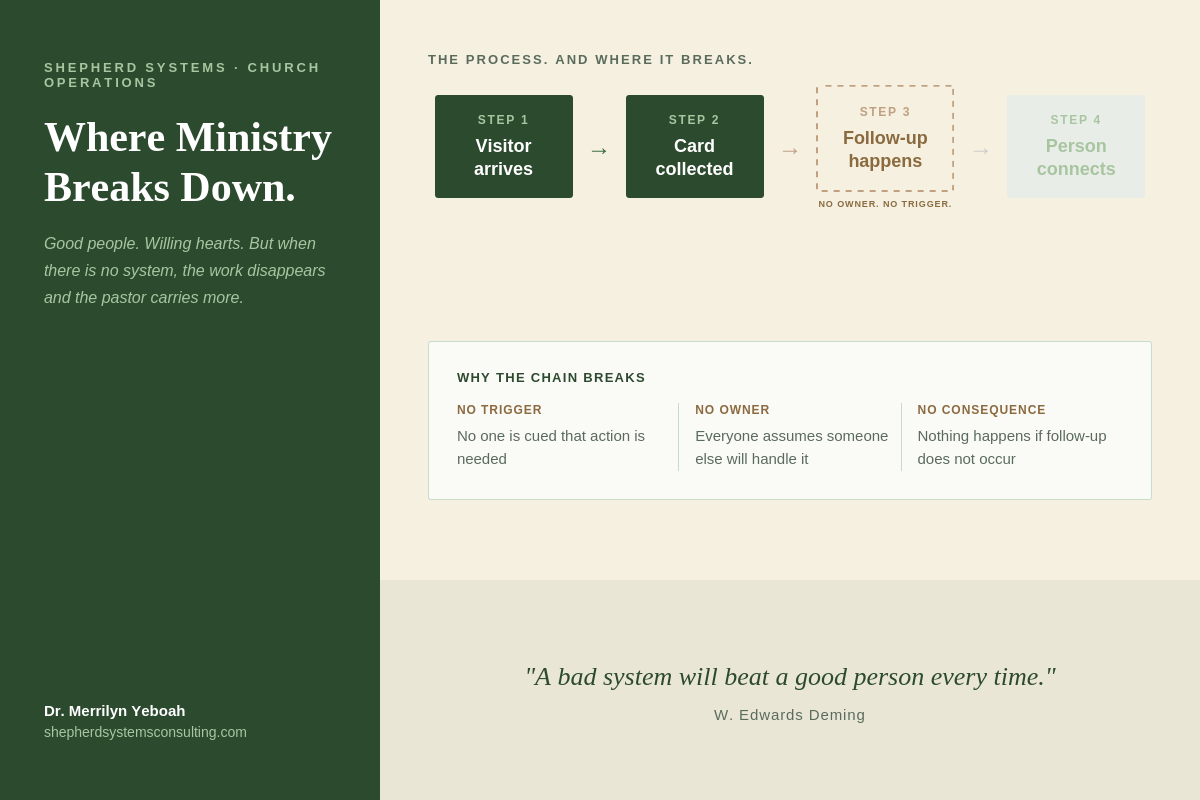
When I work with a church as a consultant, I am asking operational questions, not pastoral ones. Who owns member care, specifically? What happens when a visitor comes on Sunday, step by step? When a task is assigned to a leader, how does anyone know it got done?
These are not spiritual questions. They are structural ones. And in many churches, regardless of how they are, the honest answer is: the pastor is the answer to all of them. Everything routes through one person. When the pastor is tired, grieving, traveling, or simply human, ministry stalls.
I have seen it up close. I have felt a version of it in my own context. That is not a faith problem. It is a systems problem. And systems problems have structural solutions.
What I don't do
I do not tell a church what to believe about discipleship. I do not design the theological content of your small groups. I do not decide who qualifies for pastoral care or what that care should look like. I do not set the vision, preach the Word, or do the relational work that only a shepherd can do.
What I do is build the pathway so that discipleship, whatever your church believes it looks like, actually happens consistently. Not just when the pastor personally drives it. Not just for the people who know to ask. Consistently. For everyone.
Think about it this way. A hospital needs doctors. It also needs hallways, scheduling systems, supply chains, and clear roles for every person on the floor. Without those things even the best doctor cannot do their best work.
I build the hallways. You are the doctor.
And then there is what only God does
I want to be honest about the limits of my work. Not just what I offer but what any operational system can ever accomplish.
I can build a visitor follow-up process. I cannot make someone stay. I can clarify who owns member care. I cannot produce genuine care in someone's heart. I can create a discipleship pathway with clear steps and named owners. I cannot make anyone grow.
That is God's work. No consultant, system, or framework touches it.
What I believe, and what Scripture shows, is that God works through order as well as through Spirit. In Acts 6 the church was growing fast and the apostles recognised they needed structure to steward that growth without neglecting what only they could do. The table-servers were not lesser. The structure was not unspiritual. It was the thing that freed the apostles to keep doing what they were called to do.
Structure is not the opposite of Spirit. It is what allows the Spirit's work to reach more people, more consistently.
Three layers. One church.
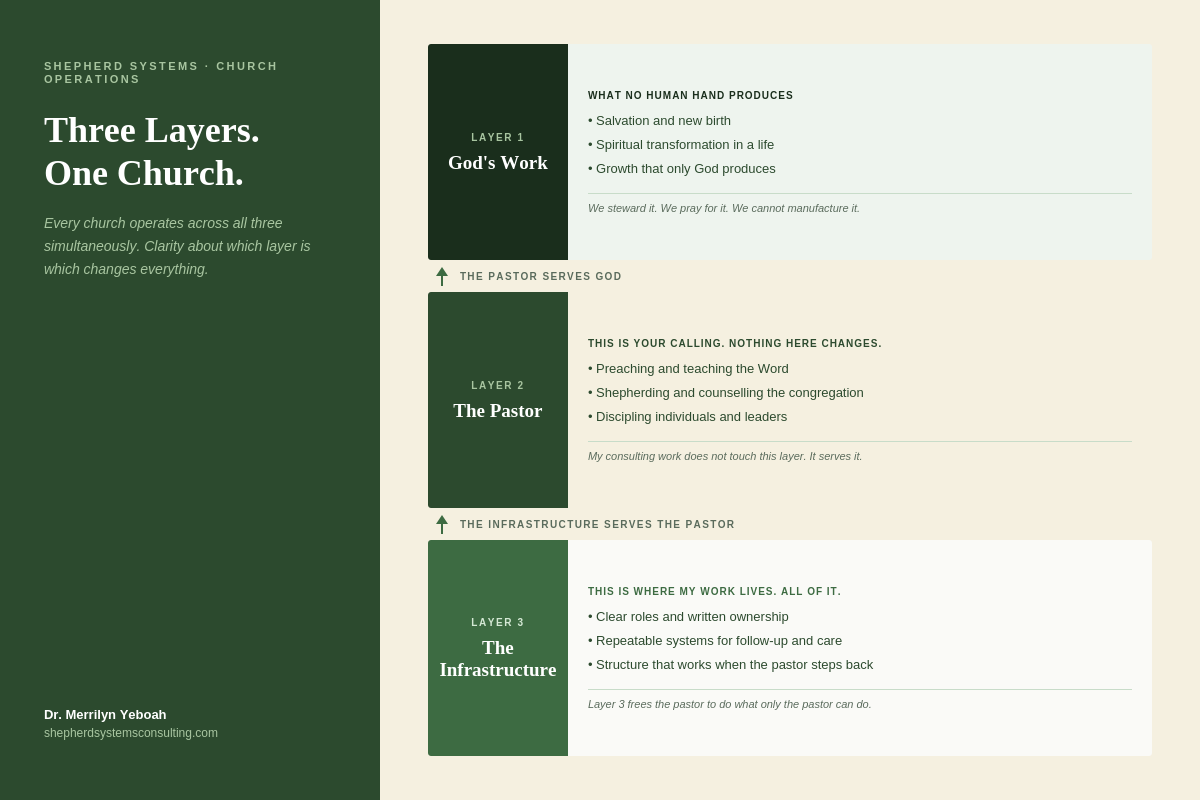
Here is how I think about it. Every church operates across three distinct layers at the same time. Confusion about who is responsible for what across those layers is where most operational breakdown begins.
The top layer belongs to God. Growth, transformation, salvation, the movement of the Spirit in a life. No human hand controls it. We steward it, pray for it, position ourselves to receive it.
The middle layer belongs to the pastor. Preaching, shepherding, discipling, counselling, carrying the spiritual weight of a congregation. This is irreplaceable, personal, and holy work.
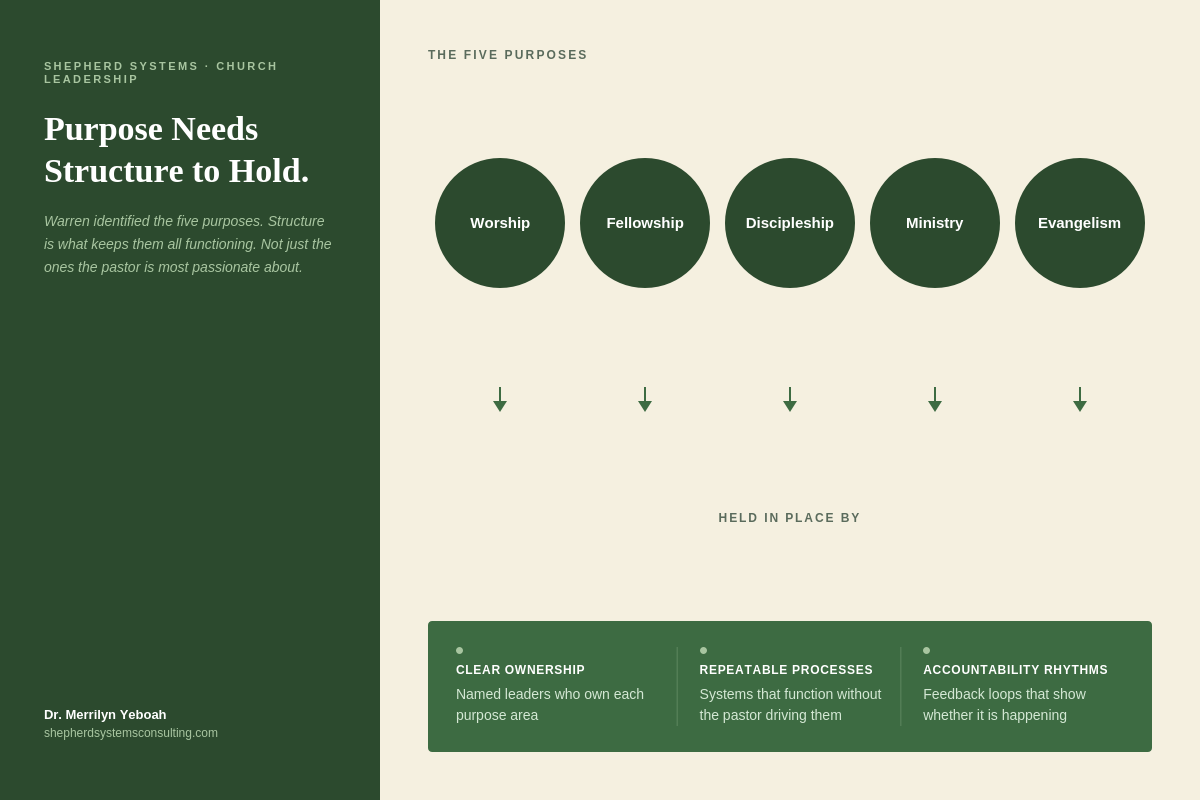
The bottom layer is infrastructure. The systems, processes, roles, and accountability structures that ensure the church's operational life functions without depending on one exhausted person to hold it all together.
My work lives entirely in that third layer. I am not reaching into the first or second. I am building the foundation that makes the other two possible.
Why I'm saying this plainly
Because I have talked to enough pastors to know the hesitation is real. Bringing in outside help can feel like admitting something is spiritually wrong. Having served in church leadership myself, I understand that instinct.
Bringing in structural help is not an admission of spiritual failure. It is the act of a good steward who recognises that the church God has entrusted to you deserves both excellent pastoral care and a structure capable of holding it up.
My experience in church leadership shapes my consulting work every day. It is what allows me to ask the right questions and build things that actually fit how a church operates. But when I am in a client church I am not there as their shepherd. I am there as a consultant building their infrastructure. That boundary is intentional and it protects everyone.
You were called to shepherd. Not to be the load-bearing wall of an entire organisation. Those are different callings.
If any of this resonates, the free self-assessment on this site is a good place to start. Or reach out directly. I am happy to have a conversation before you commit to anything.
Shepherd Systems